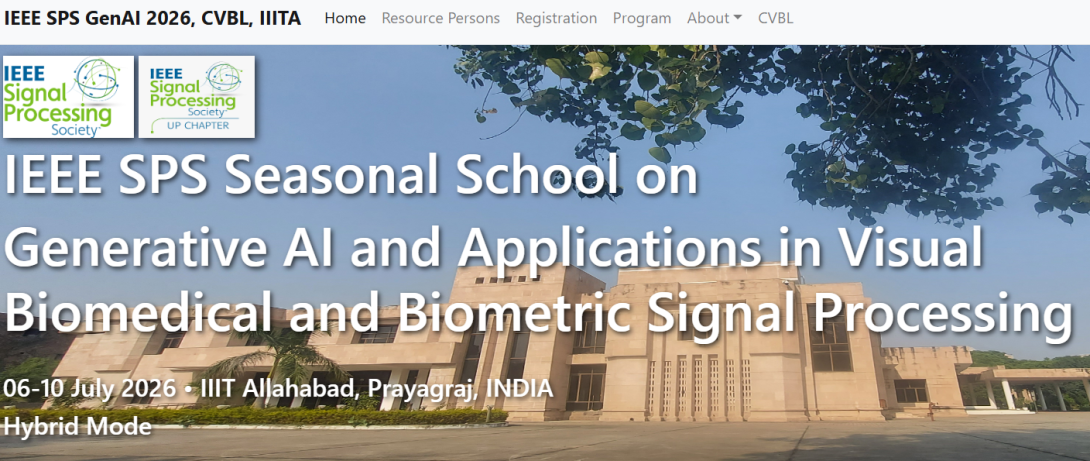
IEEE SPS Seasonal School on Generative AI (Hybrid Mode )
Generative Artificial Intelligence (GenAI) encompasses a class of computational models capable of producing novel content across multiple modalities, including text, images, audio, video, and synthetic data. These systems acquire representational knowledge from extensive training datasets through advanced deep learning techniques and subsequently generate outputs that exhibit statistical and structural similarity to the learned data distributions. The operational workflow of generative AI can be conceptualized in three primary phases: model training, task-specific tuning, and content generation. During the training phase, large-scale “foundation models” are developed by exposing neural architectures to diverse and voluminous datasets. The tuning phase further adapts these models to specialized tasks through approaches such as fine-tuning or reinforcement learning from human feedback. In the final phase, the model produces outputs that are iteratively evaluated and refined, often supplemented by mechanisms such as Retrieval-Augmented Generation (RAG) to enhance factual grounding and reduce error propagation.
- Back to previous page
- |
-
Page last updated date:09-04-2026 12:36 PM